

• 322195
| Product name | B-hLRRN1 MC38 |
|---|---|
| Catalog number | 322195 |
| Strain background | C57BL/6 |
| NCBI gene ID | (Human) |
| Aliases | NLRR-1; 2810047E21Rik |
| Tissue | Colon |
| Disease | Colon carcinoma |
| Species | Mouse |
| Application | B-hLRRN1 MC38 |

The mouse Lrrn1 gene was replaced by human LRRN1 coding sequence in B-hLRRN1 MC38 cells. Human LRRN1 is highly expressed on the surface of B-hLRRN1 MC38 cells.

Gene targeting strategy for B-hLRRN1 MC38 cells. The exogenous promoter and human LRRN1 coding sequence was inserted to replace part of murine exon 2. The insertion disrupts the endogenous murine Lrrn1 gene, resulting in a non-functional transcript.

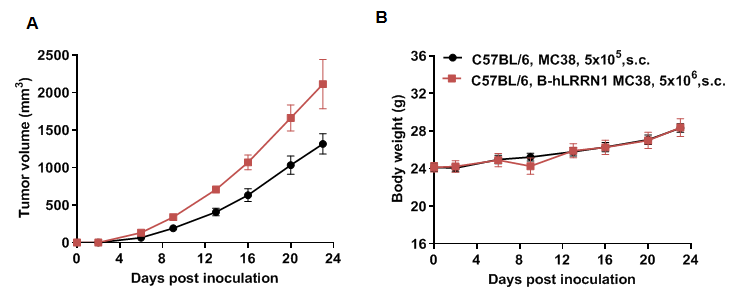
Subcutaneous homograft tumor growth of B-hLRRN1 MC38 cells. B-hLRRN1 MC38 cells (5x10⁶) and wild-type MC38 cells (5x10⁵) were subcutaneously implanted into C57BL/6 mice (male, 8-week-old, n=6). Tumor volume and body weight were measured twice a week. (A) Average tumor volume ± SEM. (B) Body weight (Mean± SEM). Volume was expressed in mm3 using the formula: V=0.5 X long diameter X short diameter2. As shown in panel A, B-hLRRN1 MC38 cells were able to establish tumors in vivo and can be used for efficacy studies.
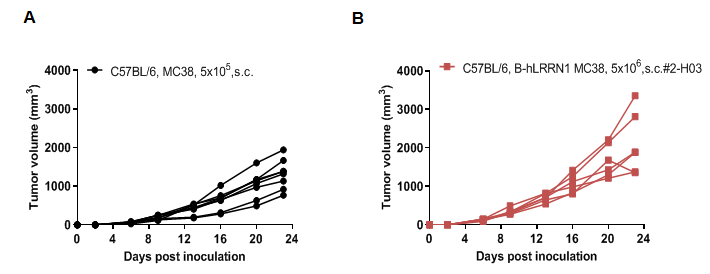
B-hLRRN1 MC38 tumor cells growth of individual mice. B-hLRRN1 MC38 cells (5x10⁶) and wild-type MC38 cells (5x10⁵) were subcutaneously implanted into C57BL/6 mice (male, 8-week-old, n=6). As shown in panel, B-hLRRN1 MC38 cells were able to establish tumors in vivo and can be used for efficacy studies.
