B-NDG hIL15, MHC I/II DKO ad mice

NOD.CB17-Il15tm1(IL15)Bcgen Prkdcscid H2-K1tm1Bcgen H2-Ab1tm1Bcgen H2-D1tm1Bcgen Il2rgtm1Bcgen/Bcgen • 114071

B-NDG hIL15, MHC I/II DKO ad mice

Product nameB-NDG hIL15, MHC I/II DKO ad mice
Catalog number114071
Strain nameNOD.CB17-Il15tm1(IL15)Bcgen Prkdcscid H2-K1tm1Bcgen H2-Ab1tm1Bcgen H2-D1tm1Bcgen Il2rgtm1Bcgen/Bcgen
Strain backgroundB-NDG
NCBI gene ID (Mouse)
Aliasesp460; scid; slip; DNAPK; DNPK1; HYRC1; XRCC7; dxnph; DOXNPH; DNAPDcs; DNA-PKcs; gc; p64; [g]c; CD132; gamma(c); IL-15; K-f; H-2K; H2-K; H2-D1; H-2K(d); H-2D; H2-D; H2-K1; IAb; Ia2; Ia-2; Abeta; H-2Ab; H2-Ab; Rmcs1; I-Abeta

在此页面上

  • Description
  • Targeting strategy
  • Phenotypic analysis

海报

查看全部

    发表文章

      Description
      • Human PBMC-engrafted humanized mice are attractive models for in vivo analysis of human immune responses. We previously reported the successful engraftment of human PBMCs in B-NDG mice. However, due to the severe xenograft versus host disease (xeno-GvHD) in these mice, the experimental window is limited. The pathogenesis of GvHD is directly related to human T cell implantation, and the mismatch between human and mouse MHCs is the main cause of GvHD after human PBMCs engraftment. It has been shown that knocking out MHC I and/or II molecules in mice can reduce GvHD and extend the experimental window after engraftment of human PBMCs.
      • MHC class I molecules are composed of two subunits, α and β chains, and the α chain in NOD background strain of mice is encoded by H2-K1, H2-D1 gene. Knocking out H2-K1 and H2-D1 gene in mice makes it unable to form a complete MHC Class I molecule. MHC class II molecules are also composed of two subunits, α and β chains, and the β chain is encoded by H2-Ab1 gene. Knocking out H2-Ab1 gene in mice makes it unable to form a complete MHC Class II molecule. These incomplete MHC Class I and MHC Class II molecules will not be able to effectively express on the cell surface and perform antigen-presenting functions, thereby potentially reducing the occurrence of GvHD.
      • Human IL15 is a key homeostatic cytokine for peripheral NK cells, promoting their survival, expansion, and functional maturation, and it also supports CD8 T-cell maintenance and effector function. In PBMC-humanized mice, expression of hIL-15 enhances overall human immune reconstitution, with a particularly pronounced improvement in NK-cell engraftment and persistence. Depending on the study design, IL15–driven immune activation may also modulate T-cell expansion and function. 
      • Application: B-NDG hIL15, MHC I/II DKO ad mice can be used to enhance PBMC-driven human immune reconstitution—especially T cells and NK cells—while reducing GvHD for immuno-oncology and immune cell therapy studies.
      Targeting Strategy

      Gene targeting strategy for B-NDG hIL15, MHC I/II DKO ad mice. The CDS region of the human IL15 gene was inserted after the 5′UTR of the mouse Il15 gene in B-NDG hIL15 mice. The exons 2-8 of mouse H2-K1 and H2-D1 gene, the exons 2-4 of mouse H2-Ab1 gene were knocked out in B-NDG MHC I/II DKO mice ad. So the transcription and translation of mouse H2-K1, H2-D1, H2-Ab1 genes will be disrupted. B-NDG hIL15, MHC I/II DKO ad mice were obtained by crossing B-NDG hIL15 mice with B-NDG MHC I/II DKO ad mice.

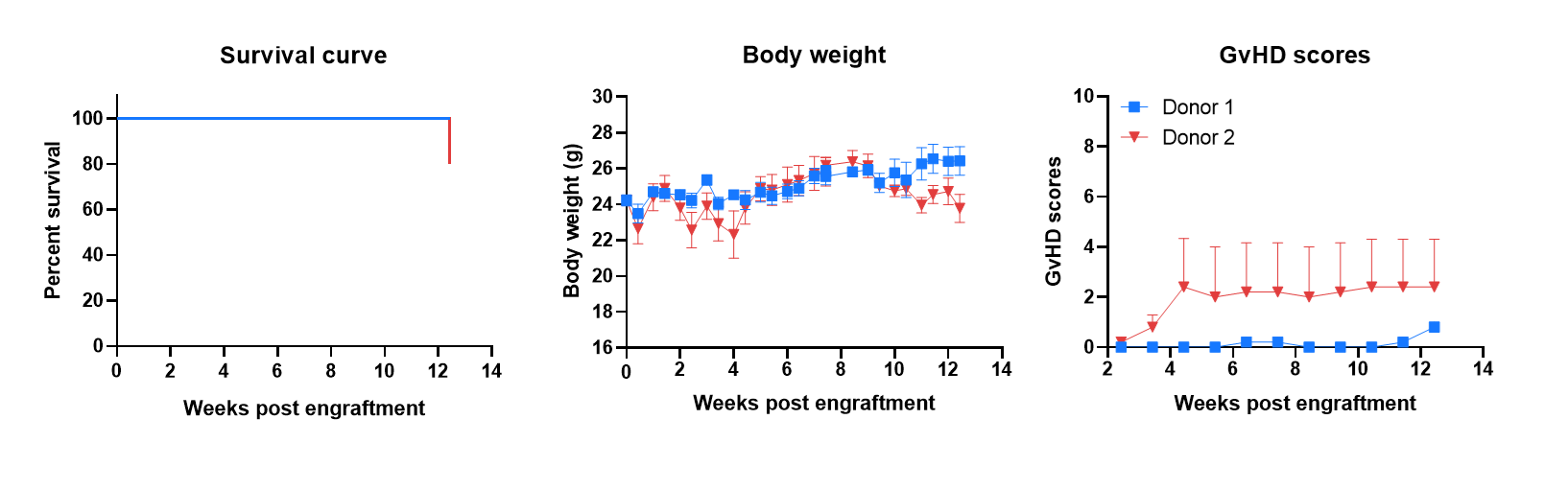
      huPBMC-B-NDG hIL15, MHC I/II DKO ad mice Can Extend the Window Period of Experiments

      B-NDG hIL15, MHC I/II DKO ad mice has a long life span and reduced severity of GvHD when engrafted with human PBMCs. B-NDG hIL15, MHC I/II DKO ad mice were engrafted intravenously with human PBMCs (1×10⁷) on day 0 (n=5). Survival rates of the mice were analyzed with Kaplan Meier survival curves. Body weight was measured twice a week. Clinical signs of GvHD were scored once a week. Euthanasia was implemented when the body weight decreased more than 20%. Meanwhile, the GvHD score of the mouse was recorded as 10. Values were expressed as mean ± SEM.
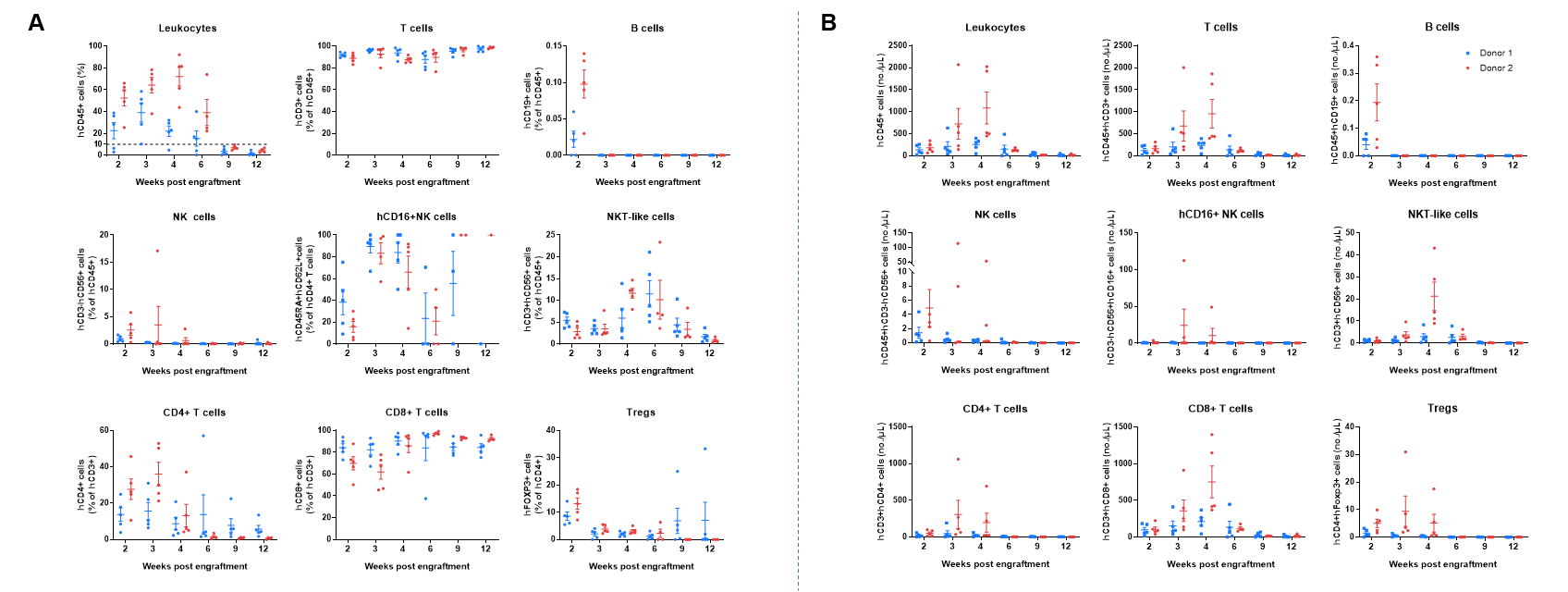
      Reconstitution Level of Human Immune Cells by Human PBMCs Engraftment

      Human PBMCs were successfully reconstituted in B-NDG hIL15, MHC I/II DKO ad mice. B-NDG hIL15, MHC I/II DKO ad mice were engrafted intravenously with human PBMCs (1×10⁷) from two donors on day 0 (n=5). Peripheral blood was taken to analyze the reconstitution level of human immune cells. A. Frequency of reconstituted human immune cells; B. Absolute cell number of reconstituted human immune cells. The results showed that two weeks after the reconstitution of human PBMCs in B-NDG hIL15, MHC I/II DKO ad mice, the frequency and absolute cell number of CD45+ cells in peripheral blood began to increase. The frequency of reconstituted human T cells exceeded 90% from three weeks and continued to rise, eventually reaching nearly 100%. Reconstituted human T cells include CD4+T cells, CD8+T cells and Tregs. A small amount of NK cells and NKT-like cells can also be detected. Values were expressed as mean ± SEM.

      * When publishing results obtained using this animal model, please acknowledge the source as follows: The animal model [B-NDG hIL15, MHC I/II DKO ad mice] (Cat# 114071) was purchased from Biocytogen.
      站点地图