Description
- Interleukin 34 (IL34) is a secreted cytokine identified as an alternative natural ligand of colony-stimulating factor-1 receptor (CSF1R/CD115/c-FMS), sharing this receptor with CSF-1 (M-CSF) and therefore often described together as “twin cytokines”. Functionally, CSF1R is the primary signaling receptor for IL34; additional binding partners have been reported, including PTP-ζ (PTPRZ1) and syndecan-1 (CD138), which may modulate context-specific activities. IL34 expression is relatively tissue-restricted at steady state and is prominently produced by keratinocytes in skin and neurons in the brain; stromal/lymphoid niche cells such as follicular dendritic cell–like cells have also been shown to provide IL34 capable of driving CSF1R-dependent monocytic differentiation.
- Biologically, IL34–CSF1R signaling supports survival, proliferation, and differentiation of the monocyte–macrophage lineage, with downstream pathways including PI3K/AKT and ERK1/2 (among others) that promote myeloid cell fitness and maturation programs. In both mice and humans, IL34 is strongly linked to the development and maintenance of tissue-resident macrophage populations (e.g., microglia-like or Langerhans-like lineages) and can shape macrophage functional polarization, thereby influencing phagocytosis, immune regulation, and tissue remodeling. In disease, IL34 is frequently upregulated in inflammatory conditions and is implicated in tumor-associated macrophage–driven immunosuppression and therapy resistance, making the IL34/CSF1R axis a potential biomarker and therapeutic target.
- The full coding sequences of human IL34 gene that was driven by SV40 promoter were inserted into mouse Hipp11 locus (Igs2) in B-NDG hIL34 mice.
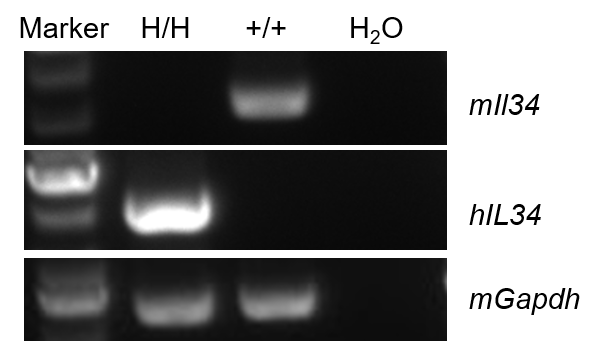
- Human IL34 was only detectable in B-NDG hIL34 mice.
- Application: B-NDG hIL34 mice provides sustained human IL34 niche signals to enhance human HSC-derived myeloid reconstitution and functional maturation of monocytes/macrophages (including tissue-resident macrophage-like cells), enabling mechanistic studies and in vivo evalsuation of IL34/CSF1R-targeted therapies.
Targeting Strategy
Gene targeting strategy for B-NDG hIL34 mice. The full coding sequences of human IL34 gene that was driven by SV40 promoter were inserted into mouse Hipp11 locus (Igs2) in B-NDG hIL34 mice.
mRNA Expression Analysis in Spleen
Species specific analysis of IL34 gene expression in wild-type B-NDG mice and homozygous humanized B-NDG hIL34 mice by RT-PCR. Splenocytes were collected from wild-type B-NDG mice (+/+) and homozygous B-NDG hIL34 mice (H/H). Mouse IL34 mRNA was only detectable in wild-type B-NDG mice. Human IL34 mRNA was only detectable in homozygous B-NDG hIL34 mice, but not in wild-type B-NDG mice.
Protein Expression Analysis in Plasma
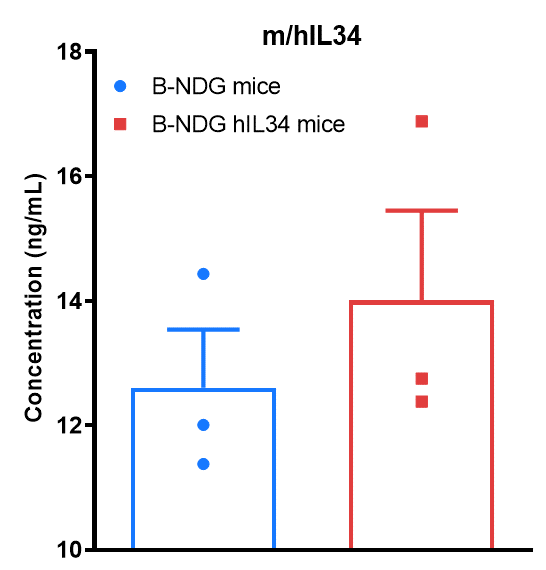
Strain-specific IL34 expression analysis in wild-type B-NDG mice and homozygous B-NDG hIL34 mice by ELISA. The plasma was collected from B-NDG mice and B-NDG hIL34 mice (male, 8 weeks old, n=3). Expression level of human IL34 was analyzed by ELISA (anti-human IL34 antibody: Proteintech, KE00151). IL34 was both detectable in the plasma of wild-type B-NDG mice and homozygous B-NDG hIL34 mice. Based on the above mRNA expression results, it is speculated that the anti-human IL34 antibody in the ELISA kit has cross-reactivity between human and mouse. Values are expressed as mean ± SEM.
* When publishing results obtained using this animal model, please acknowledge the source as follows: The animal model [B-NDG hIL34 mice] (Cat# 113407) was purchased from Biocytogen.